


Cryptocurrency lures you in with the promise of absolute financial freedom, lack of borders, and total control over your money. But let’s be honest: for a beginner, their first Web3 experience often turns into a financial trap. You download the first wallet you see in the App Store, deposit your first $100, and immediately step into a minefield.
Suddenly, you’re hit with the “gas trap” — you try to send $50 in USDT to a friend, but the network demands a $20 fee in Ethereum, which you don’t even own, leaving your money stuck. Then come the hidden fees and slippage on decentralized exchanges, where you lose 10-15% of your deposit in a single click without even understanding where it went. Add to that the terrifying reality of having no “Undo” button if you copy the wrong 40-character address, and the hordes of fake “support agents” in Telegram chats just waiting to steal your seed phrase.
It sounds like a nightmare, but it doesn’t have to be — if you avoid hardcore decentralization right from the start.
What a Beginner Should Actually Look For in 2026
The modern crypto market has long adapted to everyday people. To ensure your start doesn’t end in tears and a drained deposit, your first wallet must meet three golden rules:
- The Interface of a Regular Neobank. No complex charts, confusing acronyms (Gwei, Slippage), or Web3-nineties design. In 2026, a good crypto wallet should look and work as simply and intuitively as Revolut or Monobank.
- Transparent Fees. The wallet should show exactly how much you’ll pay for a transfer in plain dollars, upfront. Ideally, the app allows you to pay network fees in the same stablecoins you are sending (USDC/USDT), saving you from the headache of buying native network tokens.
- Live In-App Support. This is critical for a beginner. You must have a chat button right inside the wallet where a real human answers you in plain language. No bots and no sketchy Telegram groups.
Bonus Criteria: A Crypto Card. Why just look at numbers on a screen when you can spend them? The best solutions today offer virtual cards. It works flawlessly: you top up your balance with crypto, add the card to Apple Pay or Google Pay, and go to the store. The moment you tap your phone at the terminal, the system converts your crypto into the local currency (Euros, Zloty, etc.) in a millisecond. The merchant gets fiat money, and you pay with crypto without ever thinking about exchanges.
Trustee Plus: The Best Anti-Stress Wallet for Europe
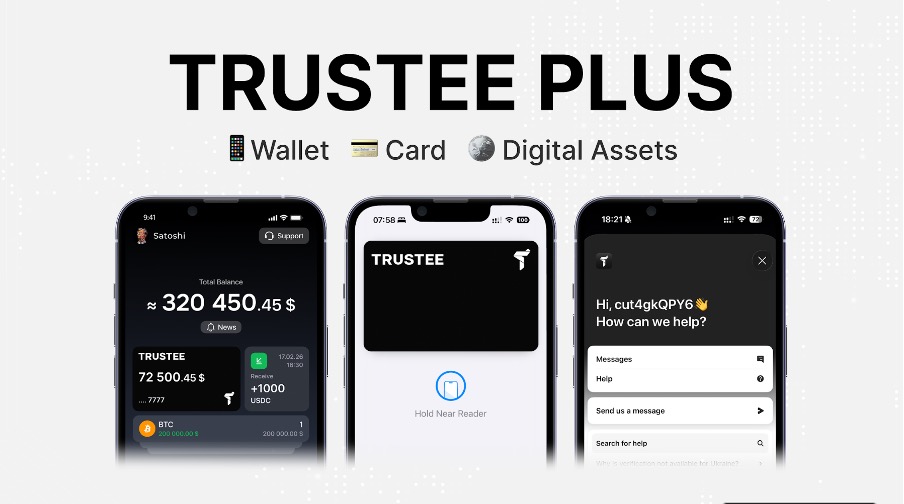
If you are in the EU and just want to use your digital money without sweating over blockchain networks, you don’t need to dive into the jungle of decentralization. Crypto-neobanks are the ideal entry ticket in 2026, and here, the absolute favorite for beginners is Trustee Plus.
Here is why it’s a literal lifesaver for your deposit and your nerves:
Personal European Account (IBAN)
This is a gamechanger that finally erases the line between crypto and traditional banking. Trustee Plus gives you a fully-fledged personal IBAN directly in the app. For a beginner, this means absolute freedom: you can legally receive a salary from an EU employer, accept regular SEPA bank transfers from relatives, and instantly convert them to crypto. Or vice versa — withdraw your USDC to anyone’s bank details. You are your own bank.
Transfers by Phone Number (The End of Paranoia)
A beginner’s biggest fear is copying a crypto address made of 40 random characters, making a one-letter typo, and sending dollars into a black hole. Trustee Plus cancels this nonsense. You simply open your phone book, pick a contact like your mom or a friend, and send them crypto. Instantly and with zero fees. You are sending money to a real person, not a faceless smart contract.
Live Support (Not Telegram Scammers)
If you get confused, you don’t need to google the problem or write in shady chats where scammers immediately attack you posing as “admins.” There is a chat button in the app: you tap it, and a real support agent answers you in normal, human language. Quick solutions, no bots, and no pre-written scripts.
A Crypto Card for Real Life
You top up your balance with stablecoins, issue a virtual crypto card, and link it to Apple Pay or Google Pay. That’s it. Go to the nearest supermarket or cafe, tap your phone, and the system automatically converts your crypto into Euros in a millisecond.
The experts at Incrypted have analyzed the market and positioned Trustee Plus right at the summit of their top crypto cards list.
Practical Guide: How to Set Up Your First Crypto Wallet (Pain-Free)
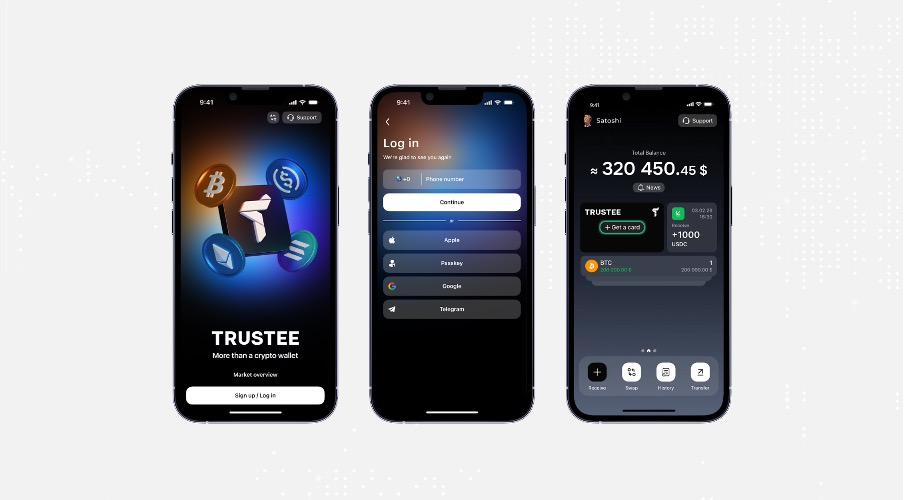
Forget about jumping through hoops. Registration today is as easy as downloading a food delivery app. The whole process takes exactly as long as brewing your morning coffee.
Stage 1: Basic Setup
- Download the official Trustee Plus app from the App Store or Google Play.
- Open the app and tap “Register”.
- Enter your phone number (or log in via Google/Apple).
- Crucial step: Secure your wallet immediately. Set up a strong PIN code and enable biometrics (Face ID or Touch ID). Your wallet should only open for your face or fingerprint.
Stage 2: Legalization (KYC) To get full access to all features (including the payment card and that European IBAN), the law requires identity verification. It’s a standard European procedure requiring only a passport or ID card.
- Tap the “Profile” icon in the top left corner of the main screen.
- Go to the “Identity” menu — it will currently show a “Not verified” status.
- Select your country of residence from the list and tap “Other method“.
- Specify the purpose of the account (e.g., select “Investments and cryptocurrencies”) and your source of funds (e.g., “Income from employment”).
- Enter your actual residential address.
- Choose your document type and simply take a selfie following the on-screen prompts.
Done! The system will send the data for review. Algorithms usually handle this in just a few minutes, after which you’ll receive a push notification of successful verification. Your personal financial bunker is ready to go.
TOP 3 Alternatives: Classic Web3 “For the People”
If you are ready to step away from centralized services, own your seed phrase (secret access key), and interact directly with smart contracts, you need a classic non-custodial wallet. We’ve selected three options that won’t blow a beginner’s mind:
1. Trust Wallet: The Absolute Mass-Market Classic

The world’s most popular wallet, installed on the smartphones of tens of millions of people. Its main advantage for beginners is its “omnivorous” nature.
- Why choose it: You don’t need to manually configure networks or search for token contracts. Trust Wallet supports almost every existing coin right out of the box. If a friend sends you a rare asset, this wallet is guaranteed to display it. It offers a highly forgiving and simple interface.
2. Phantom: Your Secure Web3 Browser
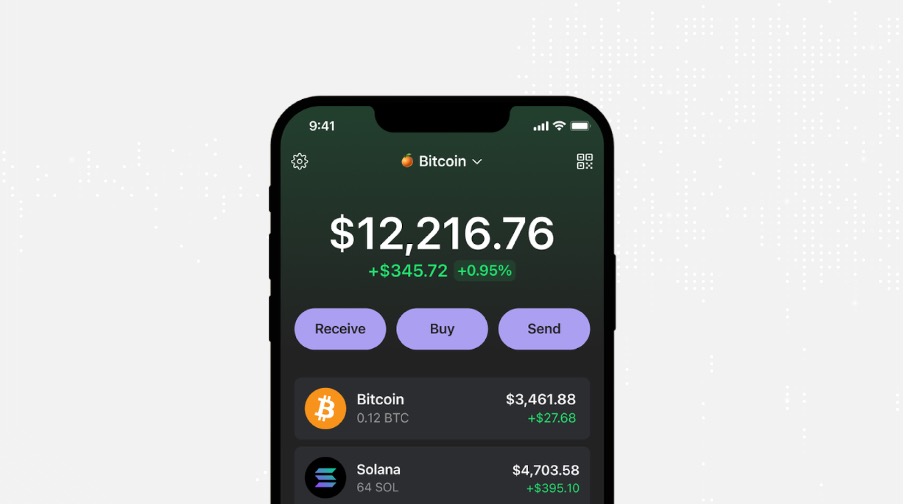
If you plan to not just store crypto, but buy NFTs, play Web3 games, or use decentralized exchanges, Phantom is your best friend in 2026.
- Why choose it (Killer Feature): The built-in antivirus. Beginners are often tricked by phishing links, but Phantom scans every transaction. If you accidentally try to connect to a scam site, the wallet blocks the action and flashes a huge red warning. It’s your personal bodyguard in the wild world of decentralization.
3. Exodus: Premium Design for Aesthetes

If you are annoyed by complex trading order books, confusing charts, and cluttered menus, Exodus will be a breath of fresh air.
- Why choose it: It is the most beautiful and intuitive wallet on the market. It looks like an expensive VIP banking app. Perfect for those who just want to buy Bitcoin or USDC, hold them on their balance, and occasionally log in to admire a beautiful pie chart of their portfolio.
Conclusion
Choosing your first crypto wallet is like choosing your first car. You don’t need a Formula 1 race car with a manual transmission just to drive to the grocery store.
Start smart. Use Trustee Plus as your financial base — for a legal salary (IBAN), stress-free phone number transfers, and daily supermarket purchases with a card. And when you feel confident enough to experiment with Web3 technologies, simply install Trust Wallet or Phantom alongside it.
In 2026, crypto is not about suffering and hacker code. It’s about your personal comfort and freedom.
Disclaimer: This is an article written by Trustee Plus, Fintechnews does not endorse and is not responsible for or liable for any content, accuracy, quality, advertising, products or other materials on this page. Readers should do their own research before taking any actions related to the company. Fintechnews is not responsible, directly or indirectly, for any damage or loss caused or alleged to be caused by or in connection with the use of or reliance on any content, goods or services mentioned in the article.
Please note this is no investment advice.
Featured image by freepik on Freepik