




Artificial intelligence (AI) is developing on a massive scale and at an accelerated pace.
By the end of the decade, annual AI capital expenditure (capex) in the US is expected to near US$1.2 trillion under a baseline scenario, according to a new report by JP Morgan Asset Management. This level of structural investment would support ongoing reinvestment, continued growth in AI end-user demand, and an expectation of financial viability.
In a more bullish “sustained demand” scenario, this sum could climb up roughly US$1.4 trillion per year by 2030. This scenario assumes a positive growth story for foundation models, agentic AI, robotics, and potentially other new modalities that would push peak capex higher and require an elevated level of investment going forward. In addition to rising demand for AI, this scenario also implies higher levels of productivity for end users and profitability for AI suppliers.
In both scenarios, AI spending is expected to start to decline somewhat towards the end of the decade. Under the baseline scenario, this would stabilize at roughly US$800 billion per year from 2034, while in the optimistic scenario, AI capex would decline from 2030 throughout 2040 to just a little over US$1 trillion.
By contrast, a more pessimistic “overcapacity” scenario assumes returns to AI providers would weaken due to price competition, insufficient demand, difficulty monetizing AI services, the technological obsolescence of capital investments, or a rising cost of capital. In this scenario, spending would peak at about US$1.1 trillion in 2028 before dropping sharply to about US$500 billion by 2033 and through 2040.
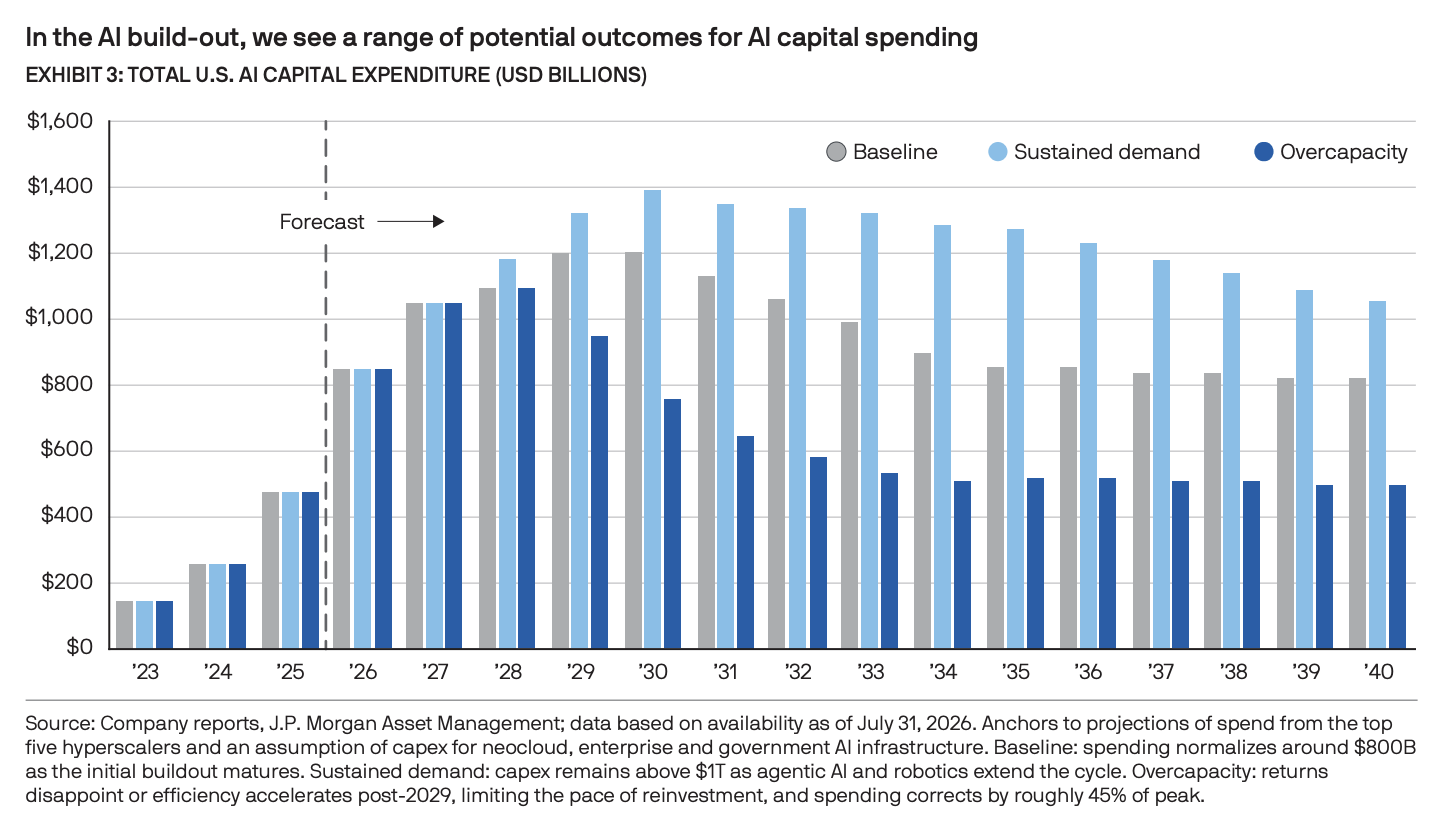
Despite different timeframes, speeds, and overall variations, all three scenarios point to a massive increase in AI investments in the short term. By 2028, total annual AI capex in the US is projected to reach about US$1.1-1.2 trillion, up from roughly US$850 billion in 2026.
The state of the AI cycle
Currently, the AI boom aligns with patterns seen in early historical examples. The JP Morgan Asset Management report notes that the cycle is moving through Phase 1 of invention and Phase 2 of capital investment growth.
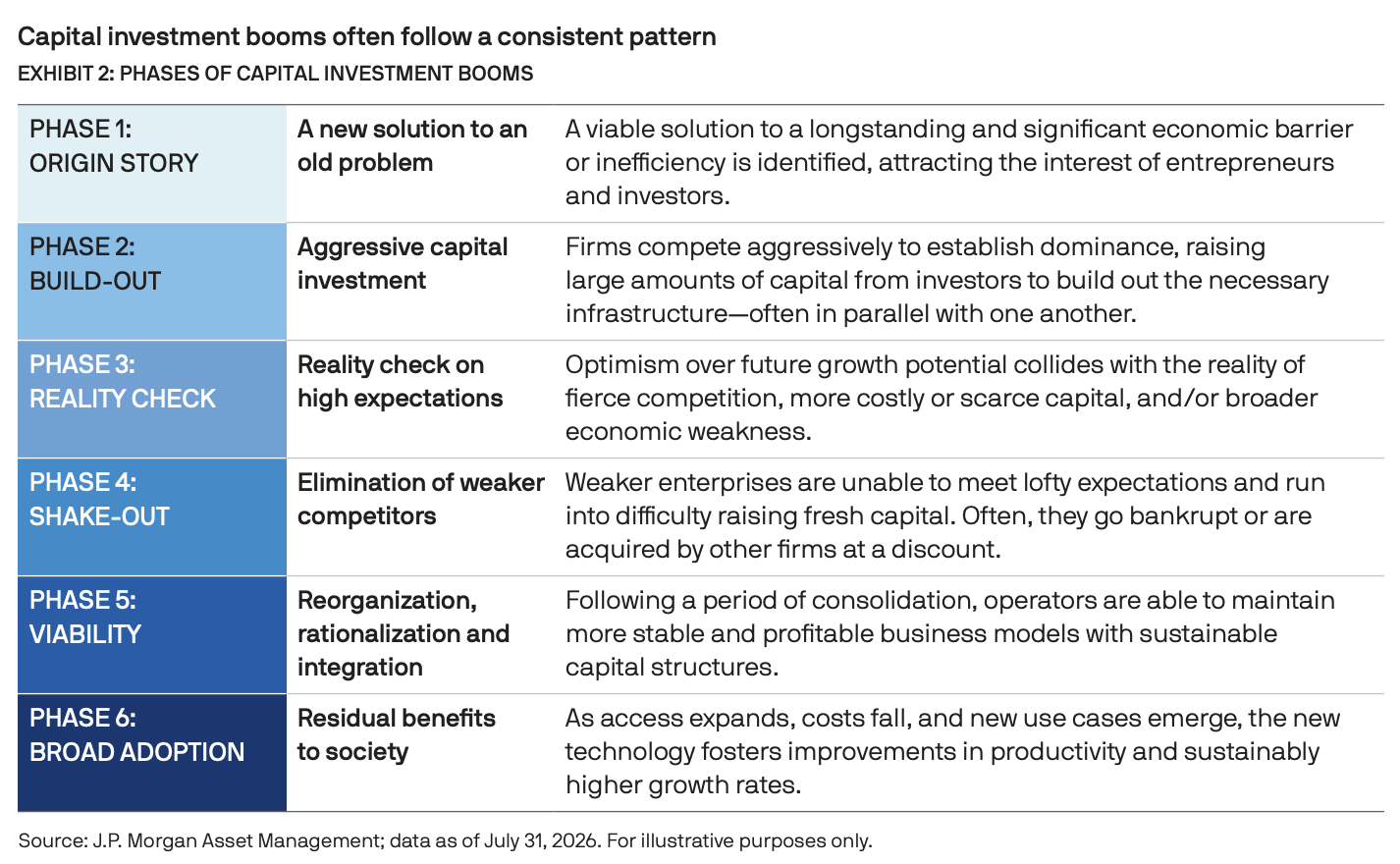
As foundation models and chip technology progress, user growth accelerates, and substantial capital investments continue to flow into the sector. This process has remained self-sustaining so far.
ChatGPT, OpenAI’s generative AI (genAI) chatbot, reports some 1.2 billion weekly users, while Google’s Gemini claims upwards of 1 billion monthly active users (MAUs). As competition among AI model providers intensifies, new use cases for AI are emerging regularly, particularly as companies adopt agentic AI.
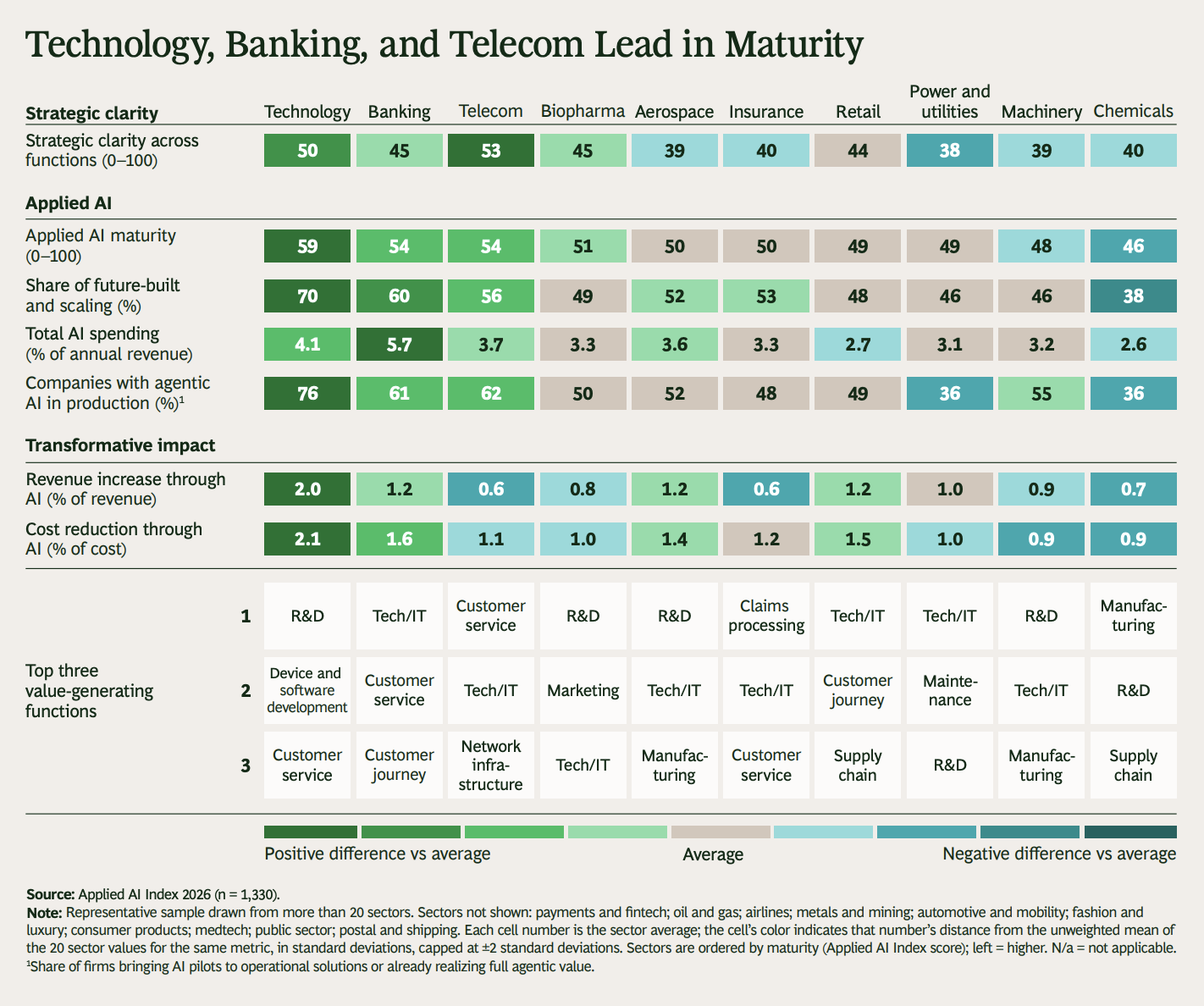
Boston Consulting Group (BCG)’s 2026 Applied AI Index, which polled more than 1,300 top executives across 20-plus sectors, reveals that a notable share of firms have agentic AI in production.
However, that proportion varies widely across industries. Technology, telecommunications, and banking lead with 76%, 62% and 61% adoption, respectively. By contrast, power and utilities, and chemicals trail at 36% each.
Europe’s AI ecosystem
Looking at regional trends, the JP Morgan Asset Management report notes that Europe has not taken a leading role in AI technology compared with the US and China, yet it remains present on the stage.
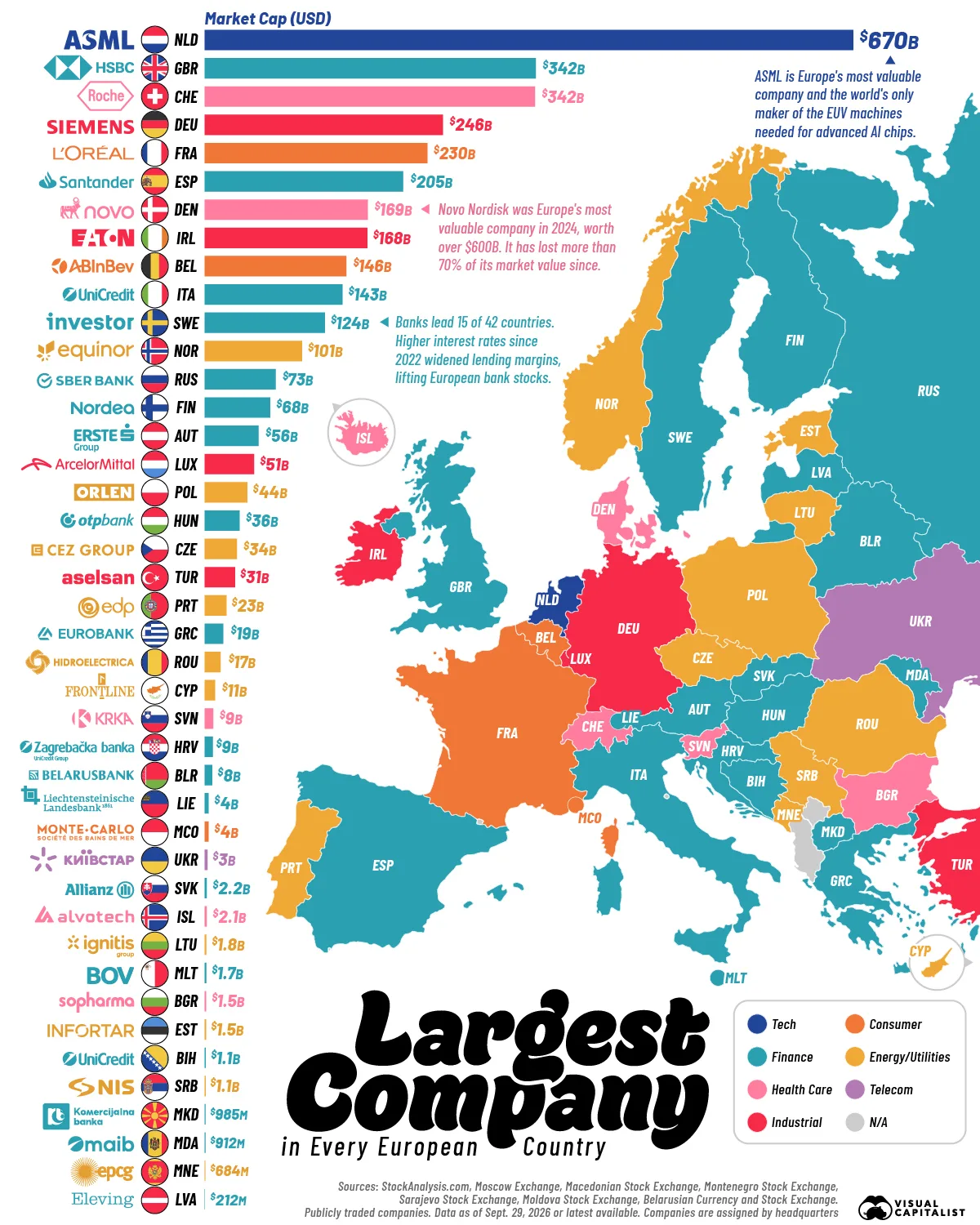
In particular, ASML occupies a unique place in the semiconductor manufacturing ecosystem. The Dutch firm develops and manufactures photolithography machines used to produce integrated circuits. It is the largest supplier to the semiconductor industry and, as of 2026, the world’s only manufacturer of extreme ultraviolet (EUV) lithography machines, which are required to manufacture the most advanced semiconductor chips.
With a market capitalization of more than US$600 billion, ASML ranks as the most valuable company in Europe.
Although Europe has not yet produced global leaders in the AI infrastructure and foundational layer, the region is emerging as a significant hub for AI applications.
According to a McKinsey and Boardwave report, the region’s AI startups increasingly focus on this part of the stack, building specialized software that can understand specific workflows, operate inside existing enterprise systems, and automate tasks in complex environments. These startups are now drawing substantial investor attention.
In 2018, European AI application funding stood at just 11% of US levels. By H1 2026, that level had climbed to 44%, with absolute European AI application funding reaching EUR 6.8 billion. The figure is as much as the total of 2024 and positions 2026 to exceed the EUR 8.1 billion raised in all of 2025.
This trend coincides with the rise of a new cohort of AI leaders in Europe. These leaders, which include names like Helsing, Legora, and Wayve, average just five years since founding, and yet already rank among the top 100 European tech companies by valuation.
Helsing is a defense AI company from France valued US$18 billion, Legora is a Stockholm collaborative AI platform for lawyers serving over 1,200 organizations and 100,000 legal professionals, and Wayve is a UK self-driving startup backed by major global tech and automotive players including SoftBank, Microsoft, Nvidia, Uber, Mercedes-Benz, and Nissan.
This article first appeared on fintechnews.ch
Featured image: Edited by Fintech News Switzerland, based on image by magnific via Magnific

